
Wicker vs Willow vs Rattan: Which Picnic Basket Material Actually Wins?
If you have spent an afternoon comparing picnic baskets online, you have probably run into the same three words used as if they were interchangeable. Wicker. Willow. Rattan. Most buying guides put them in a row, score each one, and hand you a winner.
That framing does not survive contact with a real order. Two of those words are materials. One of them is a method.
This piece untangles the three properly, then gets to the part buyers actually need, which is how to spec a basket that will still look right after a season of handling.
The word wicker describes a technique, not a plant
Wicker comes from an old Scandinavian word for bending. It describes material that is pliant enough to weave, and it says nothing about which plant that material came from.
A wicker basket can be willow, rattan, bamboo, seagrass, water hyacinth, wood chip, paper or plastic. All of them are wicker. A supplier who quotes you wicker without naming the plant has told you almost nothing about the basket.
We get quote requests every week that just say wicker, and the first thing we have to do is ask the buyer to pick a material.
So the practical rule is this. Do not compare on the word wicker. Ask what the strands are made of, then ask how those strands were prepared.
What the weave itself tells you
Wicker covers a family of weaves rather than one pattern. The plain weave is a simple over and under. Twill steps across two strands at a time and builds a diagonal surface. Herringbone reverses direction at intervals. Double wall puts a load bearing inner basket inside a decorative outer one.
Density matters more than most buyers expect. A tight plain weave resists sagging and stops small items falling through the gaps. A loose weave dries faster and reads lighter, which is why decorative baskets use it and working hampers do not.
The frame matters as much as the panel. Rims, handles and lid edges are built from heavier material than the body, usually bound with cane. When a basket fails, it fails at one of those joints rather than in the middle of a panel.
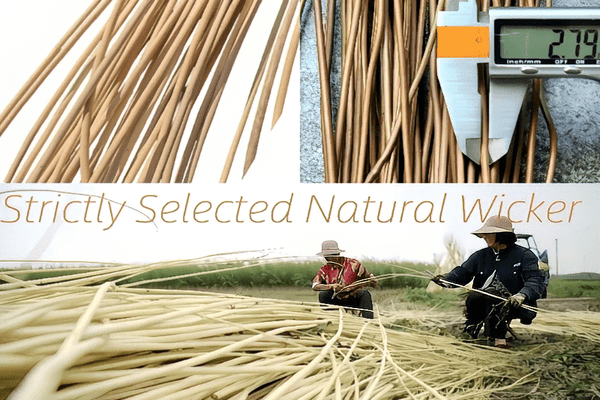
Willow is the material behind the classic picnic basket
Willow is a fast growing shrub, cut on an annual cycle and sorted by length and flexibility. It bends around a rim without cracking, which is exactly why the traditional English hamper is a willow basket.
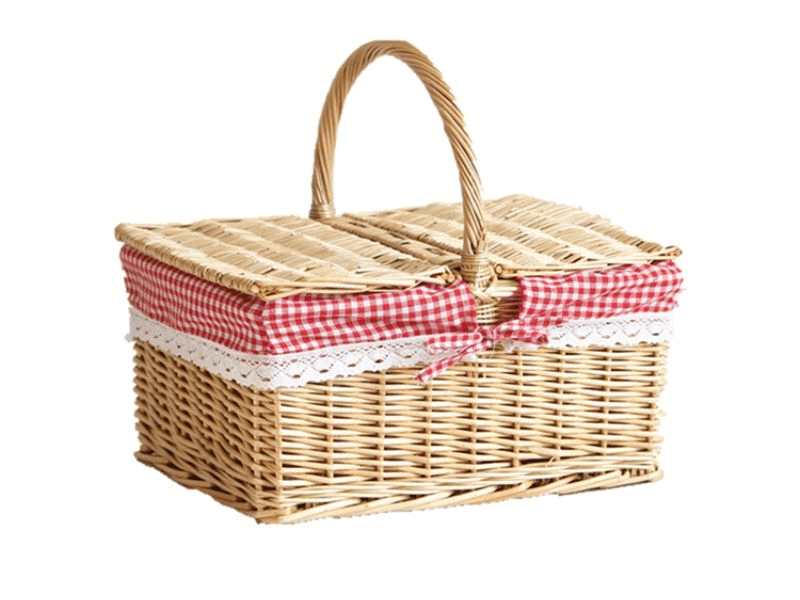
Willow is thin, light and inexpensive, and it takes dye well. That combination is why it dominates the lower and middle of the market, and why almost every red gingham lined basket you have seen is willow underneath.
Its weakness is moisture. Willow strands absorb water, and a basket stored damp will grow mold inside the weave and slowly lose tension. Once the weave loosens, the shape does not come back.
Willow grades: buff, white and brown
Three preparations show up in trade quotes and they are not interchangeable.
Buff willow is peeled and boiled. Boiling releases the natural dye in the bark and turns the strands a warm caramel, which is the tone most people picture when they hear the word wicker.
White willow is peeled and air dried without boiling, so it stays pale and slightly green. It takes color more predictably, and it is what you want under a bright lining fabric.
Brown willow keeps its bark. It looks rustic, the strand diameter varies more, and it is the cheapest of the three. For a farm shop or a festival range that should read as handmade, that unevenness is a feature rather than a defect.
The grade changes the look and the price of the same basket shape, which is why two quotes for a willow hamper can sit far apart and both be honest.
Rattan is what keeps its shape for years
Rattan is a climbing palm from Southeast Asia. The stem is used in two forms. Round core, usually just called cane, goes into frames, handles and binding. The outer skin is stripped into flat reed and used for the woven surface.
Rattan is denser and harder than willow. Strands spring back instead of denting, so a rattan basket holds its profile under load and after years of daily handling. That is why hotel and rental baskets are usually rattan and rarely willow.
The trade off is cost and lead time. Rattan grows slowly, harvests are seasonal, and strand thickness varies between lots, so a good workshop sorts and matches before weaving starts.
Rattan sits above willow at every size we weave, and the gap widens as the basket gets bigger, because a larger basket simply needs more strands. Lead time follows the same curve, since nothing moves during the off season.
Cane is not a third material
This one causes a surprising amount of confusion in quotes. Cane is not a separate plant and not a separate category. Cane is rattan, cut from the outside of the same stem.
When a product description mentions a cane handle or a cane bound rim alongside a willow body, it is describing a mixed construction. The panels are willow, the load bearing parts are rattan.
That mix is often the best value in the whole category, because the expensive material is only used where strength is actually needed.
How the three behave in the hand
Weight for the same capacity is the first difference. Willow is lighter and slightly springy. Rattan is heavier and stiffer, with a firmer knock when you tap the side.
Moisture is the second. Willow takes on water, swells a little, then shrinks as it dries, and repeated cycles loosen the weave. Rattan absorbs much less and recovers its shape better. Neither likes standing water, but only one of them forgives a damp stockroom.
Shape memory is the third. Press hard on a willow panel and it creases and stays creased. Press hard on rattan and it flexes back. This is the single biggest reason rattan baskets survive shipping and rental use better than willow ones.
Repair is the fourth. Both can be re-bound at the rim and both can be re-lined. A collapsed willow panel is difficult to reset. A rattan panel usually needs the binding tightened and nothing else.
Cost is the fifth, and it is not close. Willow wins on unit price at almost any volume. Rattan wins on how many seasons the basket lasts. Which one is cheaper depends on the answer to the second question, not the first.
How material choice changes what actually fits
Two baskets can measure the same on the outside and hold different amounts, and the material is the reason.
Rattan strands are thicker than willow strands. To get the same wall strength, a rattan body needs a deeper section, which eats into the inside. A 16 in (40 cm) rattan hamper will feel more cramped than a willow hamper of the same external length.
Lining changes it again. A padded cooler lining takes up more room than a plain cotton one, and a double wall basket loses the space between the two walls, which is often a finger's width on each side.
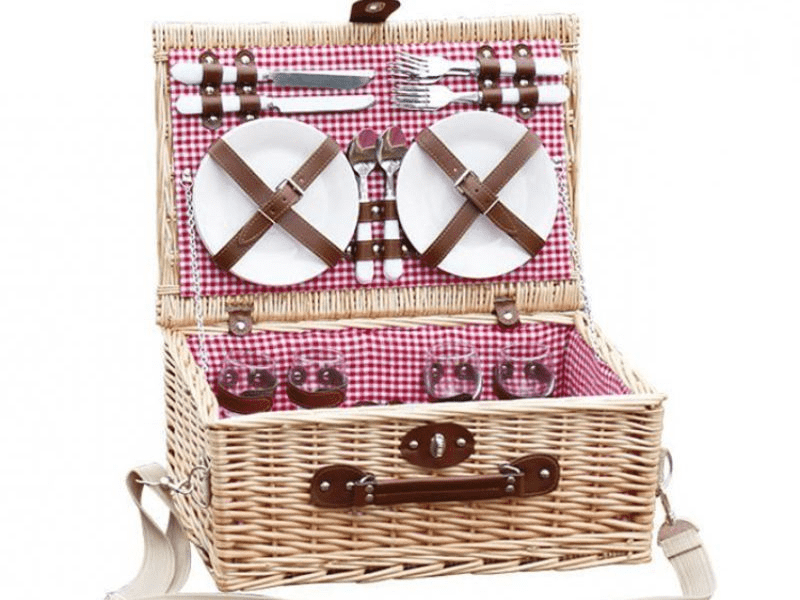
If your customer is buying a set for four people, plates and glasses have to sit flat inside the lid and the base. That is a design question before it is a material question, but the material decides how much room you have to work with.
Bamboo, seagrass and water hyacinth sit in a different tier
Bamboo is hard and dimensionally stable, but it splits along the grain and its nodes have to be sanded smooth. It works well for slats, bases and handles. It works less well for a basket that will be dropped.
Seagrass grows in salt water, so it copes with humidity better than most people expect. It also becomes brittle when very dry and it will not dye to a clean white. Its natural color is honest and slightly green, which suits coastal and rustic ranges.
Water hyacinth is soft, cheap and dries out quickly. It is a good material for a lined decorative basket and a poor one for anything that has to carry weight.
When a buyer asks for a light looking basket at a low price, this is usually what they end up with. They should know that going in.
We weave all three, and we tell buyers when they are the wrong choice for the job.
How to tell what you are holding without a spec sheet
Look at a cut end. Rattan core is solid and even, like a dense dowel. Willow shows a small pith core that is often slightly darker in the middle. Bamboo is hollow between nodes. You can almost always find an unsealed end under the rim or inside a handle wrap.
Bend a loose strand. Willow bends softly and keeps the curve. Rattan resists, then springs back. Bamboo cracks with a sharp snap if you push it past its limit.
Weigh it against its size. For the same footprint, rattan is noticeably heavier in the hand.
Check the rim. A cane binding is one continuous round strand stitched over the edge. A wrapped willow rim looks braided and feels softer under the thumb.
Smell it. Fresh willow has a faint grassy, hay like smell. Rattan smells dry and woody, closer to a hardwood floor than to a garden.
Where these baskets actually fail
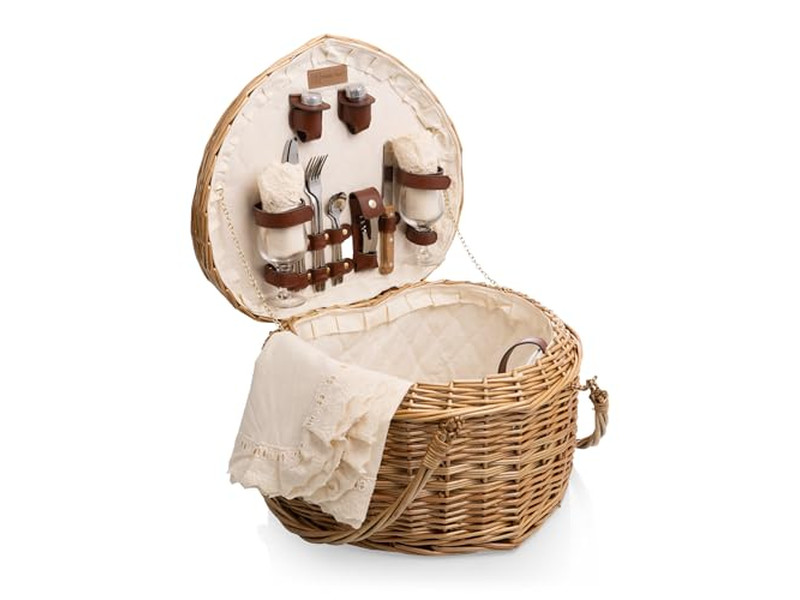
Handles go first, at the point where they meet the body. A handle stitched through the weave rather than anchored to the frame will pull out under a loaded basket, and no amount of careful packing prevents it.
Lids go second. A woven lid hinges on leather or metal tabs, and those tabs take the full torque every time someone opens it. This is why a shop display basket that gets opened fifty times a day looks tired long before a gift basket does.
Rims go third. A rim that is bound but not glued will start to lift after a few months in a busy retail environment.
Base corners go fourth, especially on square baskets that get dragged across a floor instead of lifted.
None of this is about material alone. It is about how the fittings are attached, and that is where a cheap basket and a good basket separate quietly.
Why the same basket can quote at three prices
Material grade is the first variable. Buff willow and brown willow are different products at different prices, and a quote that does not name the grade is not comparable to anything.
Weave density is the second. A tight weave takes more strands and more time per basket than a loose one, and you can feel the difference through the side of the basket.
Fittings are the third, and often the biggest gap. Real leather straps, metal hinges and stitched linings cost more than PU straps, plastic hinges and glued fabric. On a gift basket these details are the whole point. On a disposable display basket they are wasted money.
Add packing and carton efficiency and you have three quotes for one photograph.
Care, re-lining and the damp storage problem
Wicker does not need much. It needs to stay dry, and it needs to not sit in direct sun for years.
Store baskets somewhere with air movement. A sealed container traps the moisture the material brought in with it, and that is how mold starts. If a basket does get damp, dry it in the shade rather than in full sun, because fast drying is what pulls the weave loose.
Lining fabric wears out long before the weave does. A gingham or cotton lining is usually held by a few stitches or a drawstring, and replacing it takes an afternoon.
Re-lining is the cheapest way to extend the life of a basket, and it is how rental operators keep a fleet looking consistent.
What to ask a supplier, in this order
Ask for the material by name rather than the technique. Willow, rattan, bamboo, seagrass, water hyacinth. If the answer comes back as wicker, ask again.
Ask about the weave and the wall. Single wall and double wall change both the price and the rigidity, and they look different once the basket is loaded.
Ask how the material was prepared. Peeled or bark on, boiled or air dried, dyed or natural. Each choice changes the color and how long the color stays.
Ask about moisture at packing. Baskets packed before the strands are fully dry can mold inside a container, and that claim lands on the supplier regardless of who is at fault.
Ask how the handle and the hinges are anchored. This separates a two season basket from a ten season basket more reliably than the material name does.
Ask for a sample in the real color and the real size. Photographs hide strand thickness, and strand thickness is the first thing a customer notices in person.
So which one should you buy
For a gift range where the basket is part of the presentation and price drives the decision, willow is the right answer. Buff willow with a gingham lining is a proven formula and it photographs well.
For a hotel, a rental service, or any basket handled daily, rattan earns its cost. It keeps its shape, and it does not mind a humid stockroom.
For a coastal or rustic range, seagrass and water hyacinth give you a surface that willow and rattan cannot copy.
For anything structural, meaning frames, handles and binding, cane does the work no matter what the panels are made of.
Most commercial ranges end up mixing two materials on purpose. A rattan frame with willow panels, or a willow body with a cane rim, gets most of the durability at most of the price saving.
A note on how we make the call in our own workshop
Our default is to match the material to the failure the buyer will actually face. If the basket goes onto a supermarket shelf where it is picked up and set down a hundred times a week, we push toward rattan panels and cane joints.
If it goes into a gift box that is opened once on a birthday, willow is honest and cheaper. There is no reason to spend more than that.
Both are wicker. Only one of them is right for your order.
Where to go next
You can see how these materials read in finished baskets on our products page. That includes a round willow and water hyacinth hamper with a linen lining and leather straps, a four person set with two side wine tables, and a dark brown handwoven grass hamper finished with bamboo plates.
If you are choosing between two materials for a specific order, send us the basket size, the use case and your target price. We will tell you which one we would weave and which one we would not. Get in touch and we will come back with options.